)
)
)
Sustainability in Alarm Response
Balancing
operational efficiencies and customer satisfaction with costs, resources, and
legislative obligations is a challenge faced by every security services
provider offering keyholding and alarm response.
While
mobile security operations must adhere to strict compliance, with BS 7984 standard
and SIA licensing for guards at the very core of the operations, security
providers are increasingly contending with a wider range of regulations. Among
the most pressing are sustainability requirements that are prompting a
re-evaluation of long-established operational models.
From
the increased sustainability emphasis within the Procurement Act 2023, which
may influence major contract allocations, to incoming frameworks such as the UK
Sustainability Reporting Standards (UK SRS) or the Corporate Sustainability
Reporting Directive (CSRD) for the EU operations, sustainable practices have
shifted decisively from optional to essential. Yet change is rarely quick or
easy, and mobile security operations are no exception.
Operational
challenges and compliance: a system under pressure
In-house
mobile patrol operations follow strict protocols: keys are numbered, sealed,
and stored in designated, secure facilities, with quarterly audits in place.
For patrols, substantial quantities of keys are transported in reinforced
vehicles, significantly heavier than a standard transit van.
For
many established security providers, these processes have been refined over
years of practice. But increasing pressure to reduce carbon emissions is
pushing companies to reassess their approach.
At
first glance, the answer may seem simple: transition to electric fleet. In
reality, the challenge is far more nuanced. Specialised patrol vans require
higher load-bearing capacity to accommodate reinforced structures and heavy key
lockers, capabilities not yet widely matched by available electric models. And
where suitable options do exist, cost may become a limiting factor. The upfront
capital cost of electric vans (even before specialist fit-out) remains
significantly higher than for diesel equivalents. Although lower running costs
over time can help balance the investment, the initial outlay can still place
substantial financial pressure on organisations managing large mobile fleets.
An
alternative approach is to use lighter vehicles and remove key storage from
vans. But this introduces new complexities. Patrol guards may need to collect
keys from a central point for every callout, slowing response times, or
providers may need to adopt a dual-response model in which a keyless patrol
attends first and waits for keys to arrive.
Offsetting
emissions: a short-term fix, not a long-term strategy
A
seemingly simple option is to offset emissions and pursue Net Zero compliance.
Although better than taking no action, offsetting schemes remain controversial
and are often criticised as “greenwashing.”
The
core issue is that offsetting does not reduce emissions generated by day-to-day
operations. Instead, it can function as a temporary workaround, supporting
programmes with uncertain long-term outcomes. While offsetting may still play a
useful role, it is rarely sufficient on its own.
Is outsourcing the answer? The high cost of letting go
Given
these challenges and operational complexities, it is unsurprising that some
large security and facilities management organisations turn to outsourcing. On
paper, outsourcing keyholding and alarm response can eliminate the need to
transport and safeguard keys internally. No keys, no problems!
Yet,
this keyholding pass-the-parcel comes with its own risks, particularly the loss
of operational control. Providers become dependent on contractors’ processes
and performance while remaining accountable to their clients. With limited
oversight, they cannot directly influence response times, procedural
compliance, or key-management integrity. Although contractors can face
penalties for breaches, strained client relationships and jeopardised renewals
pose significant commercial risks.
Technology
to the rescue
There
is, however, room for optimism. Security technology is advancing rapidly,
enabling sophisticated remote site monitoring and intrusion detection through
AI-driven systems and IoT devices. Modern SOCs are increasingly data-led, with
enhanced capability to identify false alarms and reduce unnecessary site
visits.
As
these technologies evolve, companies must adapt, though transformation
inevitably comes with costs. In the longer term, keyless access may become the
norm, reducing reliance on physical keyholding. But that future is not yet
fully realised, and the operational challenges, along with associated emissions,
remain very much in place.
Alternative
methods gain momentum
It’s
no surprise that security providers are increasingly exploring alternative
keyholding approaches that maintain strong physical security while improving
efficiency and reducing emissions.
As
an example, one of the largest global security companies is adopting
SentriGuard, a smart key management solution across its European mobile
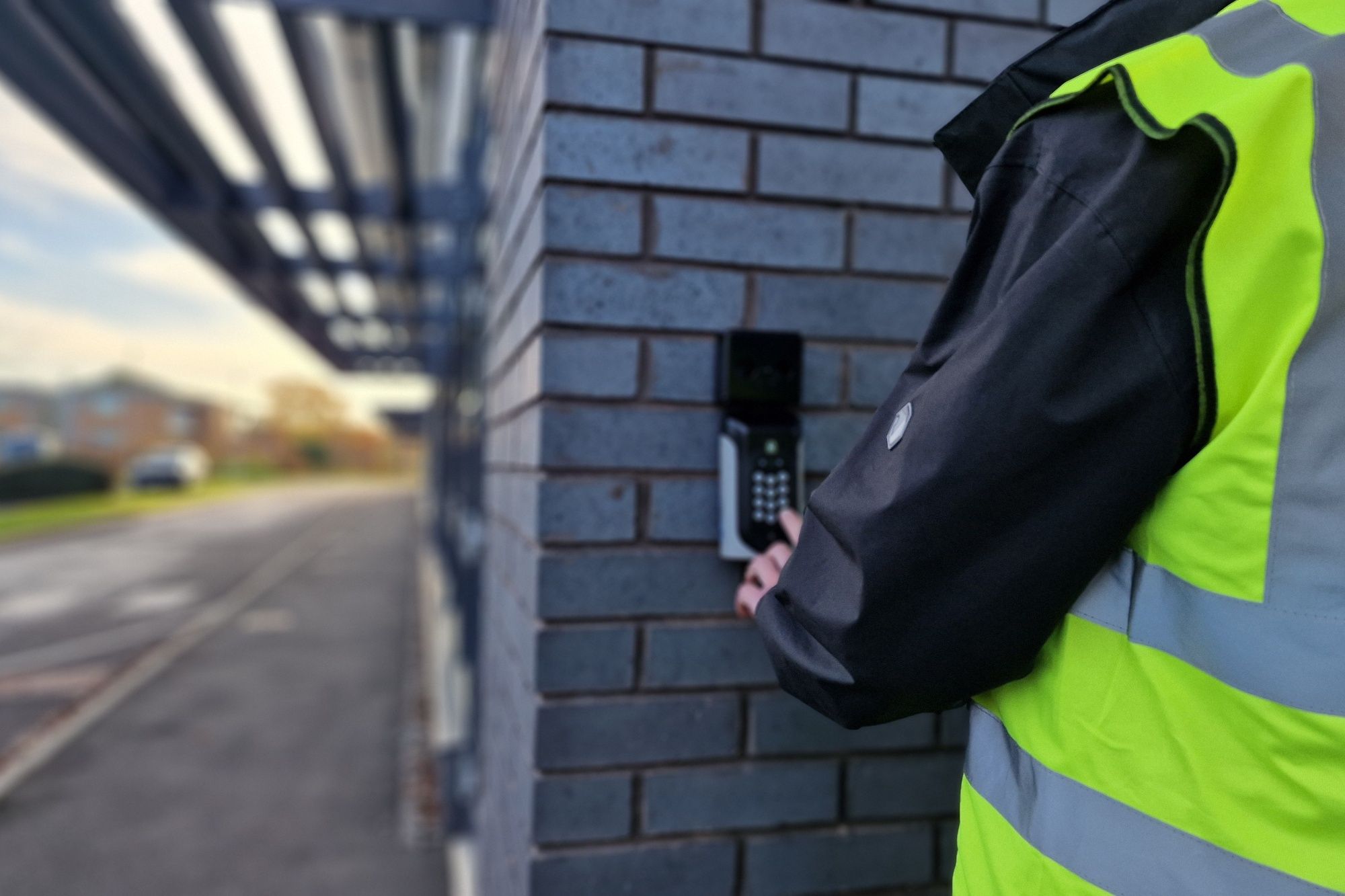
operations. SentriGuard stores keys at the point of entry in a certified key
vault (LPS 1175, SR2 – C1 & C3) and is managed remotely via a cloud-based
platform that also offers full access audit.
By
shifting to this model, the organisation is streamlining keyholding processes,
reducing audit complexity, and maintaining robust protection for commercial
customers. Crucially, it also supports more sustainable fleet management by
allowing lighter electric vehicles to be used, as keys no longer need to be
transported during patrols.
Compliance
considerations: scrutiny remains essential
Any
new solution must be accompanied by rigorous due diligence. Both the physical
and digital security of systems like SentriGuard and their alternatives require
thorough evaluation before deployment.
The
scope of assessment will depend on risk and minimum security requirements. This
may include reviewing loss prevention or security certifications, performance
ratings, ISO compliance, hardware origin, and digital security auditing.
Usability
also plays a key role, particularly the ability to revoke access for
individuals or groups remotely and run audit reports on the visits that have
already taken place. SentriGuard, for example, is managed via a dedicated
platform that enables these controls and provides additional operational
alerts, including key detection in the vaults and device battery-status
monitoring.
The future is bright. But only for those ready to adapt
Keyholding
and mobile operations are undergoing a period of significant change, driven by
environmental pressures, rising in-house operational costs, and rapid
technological development. In an era where fleet emissions can represent a
substantial share of a mobile security provider’s carbon footprint, adapting is
no longer optional.
Success will depend on embracing new technologies, rethinking long-standing processes, and investing in models that deliver both sustainability benefits and reliable service. Those who move early will set the pace for the industry, reduce long-term costs, and strengthen client confidence in a sector undergoing faster-than-expected transformation. And, perhaps, innovative systems like SentriGuard will help the sector move closer to that balance.
)
)
)
)
)
)