)
)
)
Making sure keyholding is not an obstacle in securing and turning-around void property
Releasing the Burden:
Making
sure keyholding is not an obstacle in securing and turning-around void property
Take
a walk to your local high street. Compared to a few years ago, you may notice many
more “To Let” signs in empty shop windows. It comes as no surprise given the
number of shocks to the economic system over the last five years, ranging from
COVID-19 to international conflicts, all of which have led to various
consequences, such as energy price hikes, interest rate increases, and a
general shift in many people's work patterns and consumer behaviour.
According
to Savills Research, the overall footfall of vacant retail space in the UK is
around 14.5%1,
while the total number of void private sector commercial properties stands at approximately
165,000.2 Additionally, an estimate
of 7,000 commercial and business properties owned by Local Governments in Great
Britain have been unoccupied for over 12 months.
Furthermore,
a recent BBC article points out that business tenants are more inclined to
search for smaller, newer and more energy efficient office spaces to rent, are willing
to downsize owing to hybrid working, and seek buildings that complement their
Net Zero ambitions.3
This
might be interpreted as an indication that a number of long-standing commercial
premises would become vacant in the near future, forcing owners to update and
repurpose empty spaces to meet the demands of a changing market.
A Costly Asset that Requires Extra Protection
While
the property market and customer demands are shifting, some truths remain unchanged:
commercial property should generate money, not drain it. However, void sites imply
outgoing costs and no profit, so it only makes sense that any vacant space
should be flipped as soon as possible.
Unoccupied
premises can become an alluring target for squatters, vandals, thieves and
trespassers, which is one of the main reasons why insurance companies charge
higher premiums for void property and require regular security and fire safety
checks too.
Such
properties must be protected by enhanced security measures. This often involves
the installation of steel doors and screens, perimeter protection, vigilant surveillance
and prompt alarm response. After all, any break in can cause far greater
financial damage than the costs of protection; and the owner is legally liable
for any injuries sustained by trespassers.
Meanwhile,
legit access is very much required by contractors to upgrade and renovate the site
in preparation for the next business occupier. Any delays or missed visits result
in further charges on an asset that is essentially nothing but another bill while
vacant.
Access
Issues: Fetch the Keys!
A
minor but, consequently, very important issue might arise when accessing a site
that is unmanned 24/7. For every
contractor visit, property inspection or viewing, a key must be obtained
offsite and then returned. This takes time, implies unnecessary travel and,
potentially, may result in additional missed visit fees and rebooking
arrangements in instances when a contractor is unable to gain entry. As a
result, it may slow down the void property turnaround time.
Furthermore,
complex keyholding arrangements can also slow down the security alarm response
time. More and more security companies are moving away from the traditional
keyholding model, in which keys are stored at the central location or in heavy
key lockers in vans during patrols. While reaction time is critical, time is frequently
wasted collecting keys or waiting for a keyholding patrol (rather than the
nearest one) to arrive on site.
Lock
up and leave the keys. Securely.
What
about storing keys at the point of entry? This may be controversial, but it is
a solution that has gained popularity in void property management with
implementation of secure range key safes and lockboxes.
The
primary concern in such an approach is security. Even though property is void,
the keyholding solution must be more robust than doors or other means of entry
to prevent opportunistic intruders from taking advantage of the new keyholding
arrangement.
Stuart
Wheeler, Managing Director of Keynetics, a company that offers smart key
management solutions with security-certified key safes, comments, “Over the
years, we have developed strong relationships with the top void property
management companies in the UK and Europe. These clients require a keyholding
solution that enables efficient FM service provision for vacant properties while
also providing a high level of security.”
“Storing
keys at the point of need enables quicker alarm response times and allows
approved contractors to enter the premises without any delays, but security must
not be compromised; in that respect, our SentriGuard key safes are suitable for
commercial properties and certified to LPS 1175 (Loss Prevention Standard) C1
and C3 security ratings, which is unrivalled by any other supplier.”
Stuart
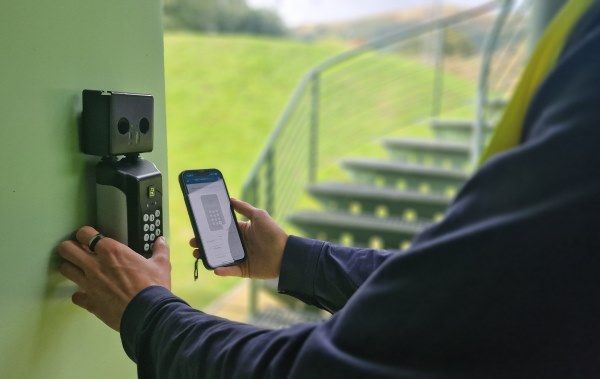
confirmed that in addition to security, the SentriGuard key management system
is highly praised for its innovative technology. First, it incorporates a
bespoke cloud-based platform that allows customers to manage access to multiple
properties remotely and generate various audit reports that can also serve as a
proof of service delivery. Second, assigned individuals may gain access to
premises either using the mobile app or a time-restricted code.
He
added, “The ability for clients to access real-time data of site visits with a
solution that does not break the bank and is secure has been the key to the
success here in the U.K. and now across mainland Europe.”
Head
to Keynetics website to find out more about the SentriGuard solution: https://www.keyneticsltd.co.uk/key-safe-solutions/sentriguard/
)
)
)
)
)
)